Wednesday, 2 September 2015

Our Lunch with KK

Last time I wrote about Kenneth Kaunda’s political career. This time I’d like to tell you about the man we met at his home in Lusaka.

KK turned ninety last year, and as he knew David Scott and the work NPAC does in Zambia, we were invited to lunch at his home. We arrived after we’d been reclaiming our luggage at the airport, so all we’d had to change into is the clothing we’d packed in our hand luggage. Fortunately I had all of my clothing in my rucksack, and so I was feeling pretty fresh, but Dad had made a schoolboy error and packed his anti-malarial medicine in his suitcase. Luckily he had a clean dress shirt, tartan tie and his Caledonian Society presidents’ medal. My Dad has great priorities.
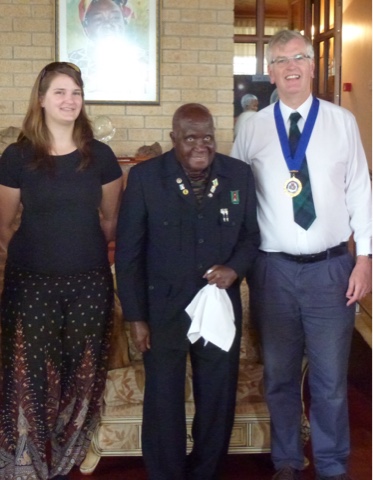

When we arrived we could hear music coming from the reception room and entered to find a bit of a jam session in progress. KK frequently has lunches to which he will invite many interesting visitors, and we were in attendance with a German music group who came to Zambia to investigate the possibility of setting up a dedicated music college. It turns out the first president of democratic Zambia has hidden talents. He’d pulled out a guitar and the whole group was singing along to a well known hymn, shortly followed by the Zambian anthem. After the musical interlude was concluded conversation turned to our purposes for visiting Zambia. KK was delighted to learn that Dad was born there, and that they had a Caledonian connection, KK’s father having been an ordained Church of Scotland missionary, and when Dad presented KK with a glass vase he had made in the colours of the saltire it took pride of place on the table in front of him. We have since learned that KK keeps the vase in his bedroom, along with the policeman’s helmet that David Scott had given him on a previous visit.


While we ate KK told us about his wife, Betty, to whom he was married for sixty-six years and who died in 2012. She was a strong woman and a good friend and advisor to KK, who consulted her frequently on affairs of state. It’s clear he misses her desperately, and his personal assistant, Linda told us that he regularly visits her grave in the gardens of his house to sit and talk to her. Dad told KK about my Mum and how they’ve been married only thirty years, and he responded with the advice to “have patience”.

KK came to the front steps to wave us off and sang Good-bye-ee, then this ninety-year-old man who has to walk with a cane ran up to his balcony like a dynamo and waved his trademark handkerchief as we drove away.

You can tell why KK was chosen to bring his country to democracy. He is gracious and commands the attention of a room when he speaks, but he is also humble and has a sense of mischief that belies the gravity of his office. He made us welcome in his home and shared his wisdom with us, while giving his full attention to each person and making it clear that he learns from everyone he meets.

First published in Southwell Life, April 2015.

Monday, 31 August 2015

Kenneth Kaunda

In 1962 my grandparents played host to a young man with a vision of a democratic Zambia. Kenneth Kaunda was 38 at the time, and president of the United National Independence Party (UNIP). Forty-eight years later my father would finally meet the man he’d peered at from behind his nurse at the age of four. The man who became the first president of an independent Zambia.

Kenneth Kaunda, known affectionately as KK, was born in 1924 in Lubwa, Northern Rhodesia, to Malawian parents. His father was a Church of Scotland missionary, and instilled in his eight children the values of the church, especially charity and love of your fellow man. KK was the youngest of the eight and trained as a teacher. In 1951 he quit teaching and became the Organising Secretary of the Northern Province Northern Rhodesian African National Congress (ANC). That’s a heck of a title, so in 1953 he became Secretary General of the ANC instead. In 1955 the ANC, led by its president Harry Nkumbula made an unsuccessful bid for the leadership of the country against the largely European led Federation of Rhodesia and Nyasaland (FRN). Later that year Nkumbula and KK were imprisoned for two months for ‘distributing subversive literature’. This turned out to be a formative experience for KK. Upon their release his friend and colleague Nkumbula changed his stance and started to sympathise more with the FRN and their view of power with property. KK disagreed with the new stance of the ANC and so in October 1958 he formed the Zambian African National Congress (ZANC). Six months later the ZANC was banned and KK was sentenced to nine months in prison.

During his early political career KK had garnered a lot of support for his view that life would never improve for black Zambians unless they were proportionally represented in government. While he was in prison some of his supporters formed the United National Independence Party (UNIP) and upon his release in 1960 he was elected president. Using his position at the head of this new party KK set about building a successful campaign. He visited Martin Luther King Jr in Atlanta, Georgia, but in 1961 the UNIP staged protests which turned to violence, leading to road blocks and arson. The 1962 elections saw a UNIP-ANC coalition with KK in the post of Minister for Local Government and Social Welfare. In 1964 UNIP gained a rousing victory with KK at its head, making him the first President of an independent Zambia.

KK remained in power until the joint pressures of economic downturn and international pushes towards democracy meant that Zambia could either spiral into civil war, or a drastic change was needed. KK implemented a ruling which allowed for multi party elections, thus effectively ending any chance he had of re-election. A free and democratic election took place in 1991 and UNIP lost to the Movement for Multiparty Democracy (MMD). He was one of the first African statesmen to relinquish power in the name of a democratic vote.


Next month I will tell you about the time that we met this hero of a man. How he commands the attention of a room, how he is a gracious and wise host, and how he plays a mean guitar.

First published in Southwell Life, March 2015.

Friday, 28 August 2015

Back to Their Future

Everywhere you go in rural Zambia, it is usually the children you see first. They line the roads waving and grinning because to even see a car is a terribly rare event. They are thrilled to meet new people and will greet you over and over, to show off the English they know and in hopes of becoming friends. You are dragged over to meet their families and welcomed in to eat with them with smiles and open arms. Family is important here, because often family is all you have between you and the world, but sometimes family does not offer the safety it should. There are countless cases of the abuse of girls and young women at the hands of their male family members. For a long time this went unchecked and unchallenged, but education is helping to counter the damage done by ignorance. Project Luangwa works to educate young people, to help make their lives better. At present they are focusing on teaching young women that they do have a choice about what happens to their bodies, and teaching young men that they too have a choice. Tradition does not have to dictate their future, and they do not have to bow to pressure from ‘the way it has always been’. There is no shortage of minds to soak up knowledge and combat ignorance. The schools we visited with the National Police Aid Convoys (NPAC) were bursting at the seams with children so keen to learn that they even did what their teachers told them!


PEPAIDS is another charity which aims to educate, in particular, young people who have been affected by HIV/AIDS. Often these children are the sole carers for sick relatives or younger siblings, so when PEPAIDS gives them the chance to have some time off they leap at it. Camp Zambia is run so that children and young people can come and learn some life skills, as well as being able to relax and be children for a while. One particularly heartwarming story is that of Jack. His father had died and his mother was seriously ill, so he was the head of the family, responsible for caring for his siblings and his mother. He came to camp Zambia with nothing more than the clothes he stood up in. He didn’t even have any shoes. Volunteers at the camp got him to stand at one side of the yard and imagine everything he could want on the other side. He told them he just wanted to feed his family. They asked what he had on his side of the yard, and how it could help him get to the other side. He had a slingshot to scare off monkeys, so he decided he could go out into the bush and catch guinea fowl. This he did, and his family had a decent meal for the first time in weeks. One day he caught two guinea fowl, so he took the spare and sold it at market. With the money he bought himself a pair of pink jelly sandals, meaning he could walk further into the bush and thus catch more fowl to sell.
They say the children are the future, and Zambia’s future must be bright!

If you’re interested in the work done by any of the charities mentioned, please take a look at their websites:
Project Luangwa: www.projectluangwa.org
PEPAIDS: www.pepaids.org

NPAC: www.npac.org.uk

First published in Southwell Life, February 2015.

Wednesday, 26 August 2015

Charity Connections

The National Police Aid Convoys was founded on a basis of strong links in the community. During the Balkan war local police officers used their knowledge and connections to deliver aid directly to people in need. NPAC now sends shipping containers to around a dozen countries around the world from Albania to Zanzibar. Freight costs are high for regions that are less accessible but money raising efforts through warehouse sales, talks and presentations, legacies and donations keep the aid moving. A recent talk by three Southwell dentists at the Bramley Centre library raised £315 for NPAC, Bridge 2 Aid and the Mercy Ships. NPAC have to plan a long way ahead how much aid to send and where it’s needed. We use out links with local people and visits in person to find out if aid has arrived, is being used, and is being looked after. As long as these three criteria have been fulfilled we will offer more support in the future.

NPAC has links to organisations in the UK that supply specialist items such as sewing machines, shoes, bicycles, and artificial limbs. There is a surfeit of equipment in this country which is perfectly serviceable; the major challenge is getting it where it can do some good. NPAC is ideally situated to provide transport that smaller charities cannot afford. The large containers that NPAC sends run at about £4000, but if a charity wants to send smaller items they are invited to pay just a share of the container so their shipment can get to where it needs to go.

NPAC has warehouses all over the East Midlands where volunteers give their time to sort through the goods donated and decide which can be sold to pay for shipping costs, and what could be better used in specific projects abroad. During our trip to Zambia my father, John Peterson, was involved in setting up the dental clinic at the Makeni Trust in Lusaka. He had sent over some equipment already, including a dental chair and some cabinetry, but there is plenty more to take out on NPAC’s next trip, in June 2015. The warehouse closest to us is gradually filling up with medical and dental equipment donated by the Nottingham Dental Society, Westbridgeford medical practices and Lincolnshire podiatrists and physiotherapists ready to be serviced and tested before shipping. John says “I have seen the difference these donations make to the people we visited and hope to do more. NPAC cannot fulfil every request that comes in but we do like to keep our promises.”


If you’re interested in the work NPAC does, check their website at www.npac.org.uk or email secretary@npac.org.uk.

First published in Southwell Life, January 2015.

Monday, 24 August 2015

African Appetisers

Mum and I are the gastronauts of the family. Brother and Sister will experiment within the food groups they like, and Dad will eat what he’s given and be grateful, but Mum and I like to do something a little different every year. Everywhere we travel influences the food we make, and heading over to Zambia opened up a whole new continent of gastronomic possibilities for me.

While we were there I crossed three new animals off my Glutton Club list. Goat – delicious stewed, tender and flavourful; impala – similarly tasty, especially breaded and fried; and kudu, which is another type of antelope. Kudu I did not like. It wasn’t an unpleasant texture, being something like tender lamb, but the flavour was unexpected, being something like tuna. It did not marry well in my head.

Most people in Zambia get their carbohydrates from nshima, the Zambian national dish. It is made by adding mealie meal, a finely ground corn flour, to boiling water, and stirring until the desired consistency is reached. The nshima is formed into a ball, and is then used to scoop up the accompaniments. Make no mistake, to Zambians this is more than a mere alibi food, nshima is the central component of the dish, and all else is frippery. My father grew up in Zambia and has fond memories of mealie meal. Indeed, most ex-Zambians speak of nshima with misty nostalgia in their eyes. It isn’t quite the same anywhere else.

The meal I enjoyed most was probably with our good friend Chieftainess Mwape. She served us nshima with goat casserole, greens, beans, carrot salad and boiled potatoes. Quite the feast, considering her village is in the middle of both elephant country and tsetse fly country. The elephants trample and eat any crops other than cotton and tobacco, and the tsetse flies cause sleeping sickness in cattle. The people of Mwape struggle for food at the best of times, but while we were there it was a particularly lean season. The river was low and the food was scarce, but thanks to the work of NPAC and the tremendous organisation of the Chieftainess, most of the people of Mwape will not need to buy clothes or supplies for school, so they will be well fed until the river rises and the crops can grow and be sold.

First published in Southwell Life, December 2014.

This was apparently the only food we took a photo of. These little golden plums were tart and refreshing, and I still don't know what they're called!

Saturday, 22 August 2015

A Binary Country

For a country so fiscally poor as Zambia, any extra income is extremely welcome. As such, a thriving tourism industry has made the most of the country’s extraordinary beauty. Its geography and wildlife mean that it has tremendous attraction for the more adventurous tourists, literally off the beaten track, while those who appreciate their creature comforts a little more can relax in one of the many top class hotels in Livingstone. On our trip we were largely working in the bush with remote communities, but at the end of the trip we spent some time in Livingstone, to reacclimatise to civilisation after washing in hippo water for a fortnight. It was as well we did take this time to readjust. One day we were visiting schools in desperate need of basic supplies, like shoes, and the next we were amid the decadence of the Royal Livingstone Hotel, sipping gin cocktails while the sun set over the Victoria Falls and zebra roamed through the grounds.

One woman who embodied the best of both worlds within this binary country was the inestimable Chieftainess Mwape. She grew up in the Mwape district, along the banks of the River Luangwa, with her mother, the former chieftainess. When she finished school she left the area and made a new life in Lusaka. She met her husband and had children. She had a nice house and a good job, and was happy for years. Then one day she got the news that her mother had died and she had been selected as the next chieftainess. She left it all. She travelled back to the scene of her childhood, leaving her children, her friends, her life in Lusaka, and started again, building on the legacy of her mother and bringing the knowledge she had gained in the big city to bear in a very different setting.

NPAC has been working with Chieftainess Mwape for many years now, and they are impressed with the techniques she is using to ensure all the aid they send gets to the people who need it most. When the containers arrive she stockpiles everything in her guest house and puts the word out to all the settlements in her district, announcing the day that everything will be shared out. The people gather, and the first to choose are the elderly and vulnerable, followed by the families, and then the rest of the group. The first thing you touch is the thing that you take, so there is no picking over the offering for things to sell, and everyone takes what they can carry on their cart or bicycle. Baby bundles are sent to the clinic, and the new mothers do not receive anything unless they bring their children in for check-ups and vaccinations, thus ensuring they remain healthy. This strict control means that the aid sent is fairly distributed, and it is gratifying for NPAC to know that someone in such a position is working so carefully to make the most of what we can send.

If you’re interested in the work NPAC does please visit www.npac.org.uk or call 0115 9390 999.
Chieftainess Mwape and David Scott.

Monday, 6 July 2015

A Tale of Two Schools


The National Police Aid Convoys support many schools around the world, but here I would like to focus on just two of them. On their recent trip to Zambia NPAC visited schools that they have sponsored in the past including Nyimba East Primary School. Nyimba District is situated in the Eastern Province of Zambia. The headteacher of the school, Lita Zalimba has been in contact with NPAC for 10 years. She was originally a teacher at Mwape School, further west, but in 2010 she moved to the newly built Nyimba East School. In the time she has been there the school has gone from strength to strength, having been filled by generous donations to NPAC. The school is equipped with all the desks, chairs, books and sports equipment they need, and during their last visit the playing fields were levelled and kitted out with netball hoops and goal posts. The playing fields are used by many schools in the area for tournaments and the school choir is entering regional competitions. Nyimba East is a success story for Lita and NPAC, and we hope that they will continue to grow and develop talented and enthusiastic minds.


If you’d like to hear more about Nyimba East School, take a look at Andrew Whittingham’s new book “Ninety Days in Nyimba”. Andrew grew up in Nottinghamshire, and his book follows his time teaching alongside the dedicated staff at Nyimba East.

Another school that NPAC supports is Mnyazi Primary School, also situated in Nyimba District. Mnyazi is further outside the main town of Nyimba, along roads which can barely be called such. A small group of us travelled the 45 minutes to visit this school and what greeted us was something quite different to Nyimba East. There are 422 pupils currently enrolled from the ages of 6 to 22. They were very grateful for the equipment NPAC had already sent, but it was clear to see that there was much more to be done. The older children and teachers needed desks which were big enough for them, the children needed uniforms, school bags, and in some cases shoes, and the school would benefit from tools to cultivate a garden to grow food for the children.


One thing that we noticed wherever we went was the gratitude and generosity of spirit which greeted us. Both Nyimba East and Mnyazi schools insisted on their choirs performing for us, which prompted goosebumps and not a few tears. These children who are so grateful for the simplest things wanted to show us what they could do, and it was breathtaking. None of it would be possible without desks, books and materials sent by NPAC. Without this basic equipment the schools cannot retain either teachers or students and huge districts are left without the basic right of access to education. Such a huge problem is so easy to fix with excess and redundant stock from our local schools which you give to NPAC. All we do is get it where it is needed.


If you’re interested in the work NPAC does, visit their website at www.npac.org.uk.

First published in Southwell Life, September 2014.